
Why You Keep Getting Hurt (Even When You’re Trying to Do the Right Things)
Most people think injuries come down to one thing.
A bad knee.
A weak shoulder.
“Arthritis.”
Something that just needs to be fixed.
But that’s almost never what’s actually going on.
What I see over and over is much simpler, and much more fixable:
Your body broke down because of a mismatch between capacity and efficiency.
The Two Things That Actually Matter
Think of your body like a structure.
Not just how strong it is…
…but how well it’s put together.
Here’s what that looks like:
Capacity = How much load your body can handle
Efficiency = How well your body distributes that load
When both are in a good place, things feel easy. You move well. You recover well. You don’t think about your body much.
When one or both are off, problems show up.
The Four Ways People Break Down
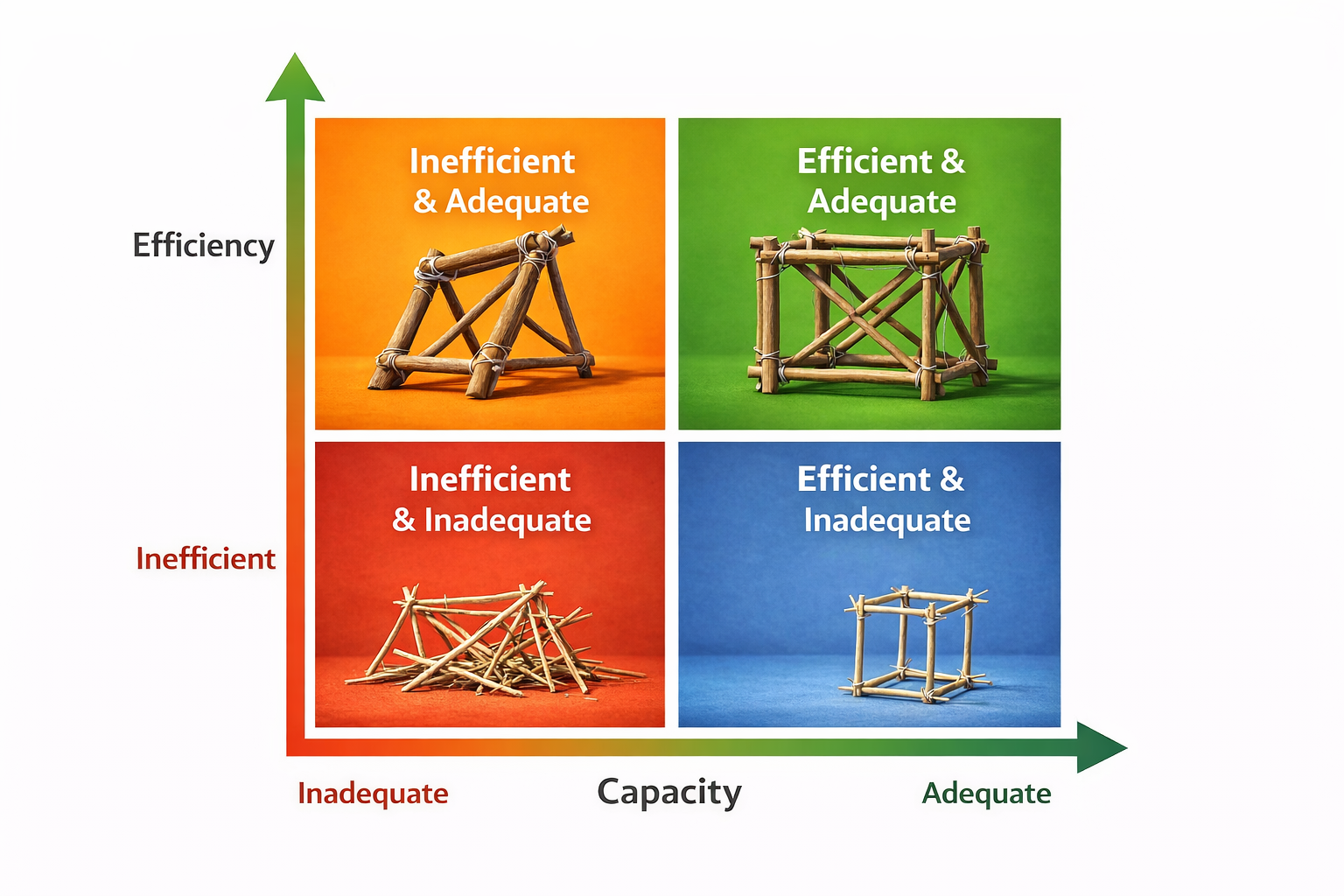
This is the simplest way to understand where people land:
1. Efficient + Adequate (Top Right)
This is the goal.
Strong enough.
Well organized.
Handles stress without falling apart.
These are the people who can stay active, play pickleball, lift, run and not constantly be dealing with pain.
2. Inefficient + Adequate (Top Left)
This is sneaky.
You’re strong enough…
…but you’re leaking force everywhere.
You can get away with it for a while.
Until you can’t.
This is the person who says:
“I don’t know what happened. I’ve always been active.”
Nothing new happened. The system was just inefficient long enough that something finally gave.
3. Efficient + Inadequate (Bottom Right)
This is the “I move well, but I can’t handle much” person.
Everything looks clean.
But there’s not enough capacity behind it.
This shows up when someone:
Returns to activity too quickly
Avoids loading because of fear
Has been resting too long
They don’t break because they move poorly.
They break because they don’t have enough in reserve.
4. Inefficient + Inadequate (Bottom Left)
This is where things feel the worst.
Poor movement.
Low capacity.
Everything feels hard.
Pain shows up easily here because there’s no margin for error.
Why “Doing More” Sometimes Makes You Worse
Most people try to fix this by doing more.
More stretching.
More workouts.
More activity.
But here’s the problem:
If your structure isn’t organized (efficiency),
and you ramp things up too quickly (capacity),
you don’t adapt; you break.
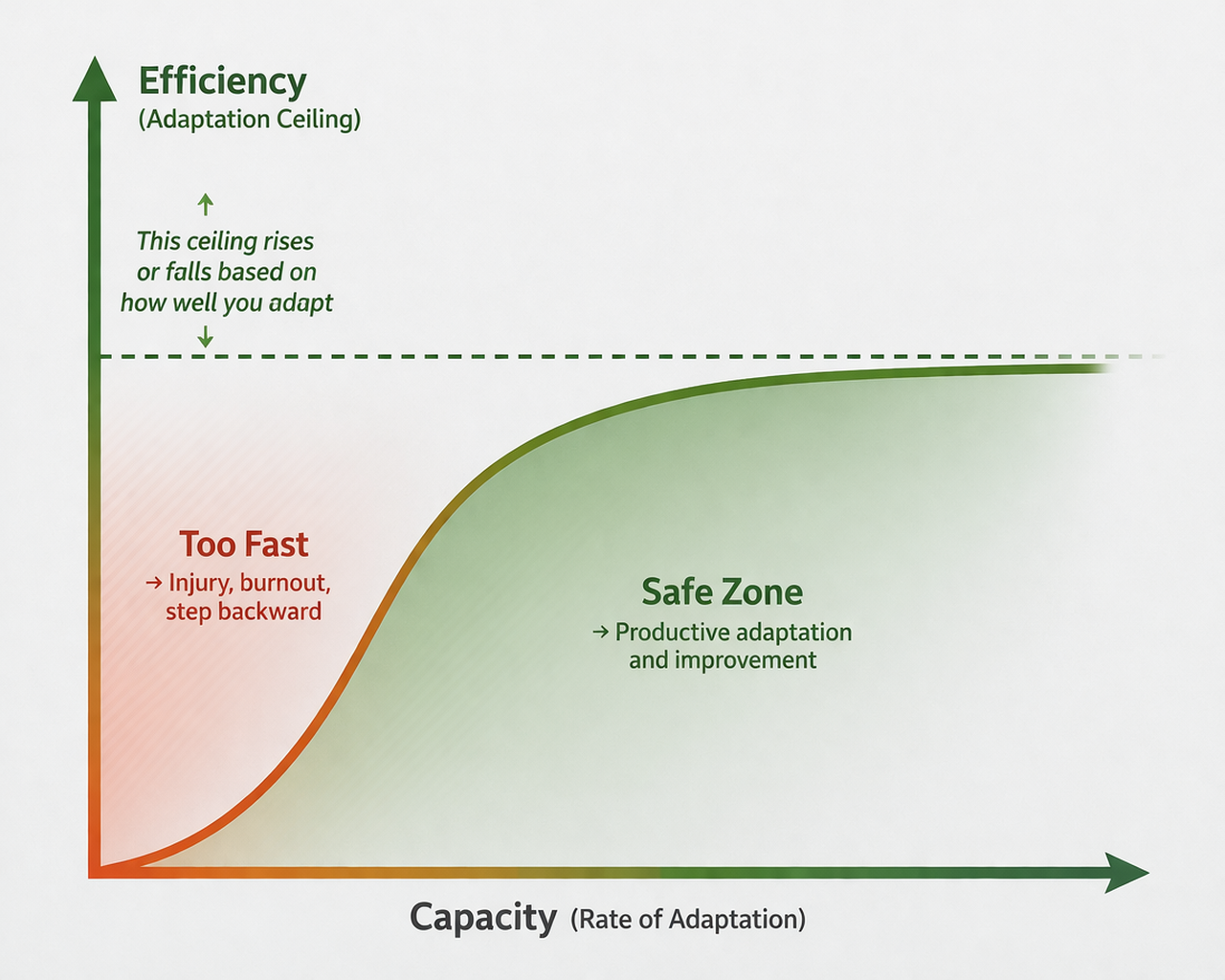
This is where most people get it wrong.
Your body will adapt.
But only if you give it the right conditions.
Two key ideas:
1. There’s a “safe zone” of progression
If you increase stress gradually, your body builds.
Stronger tissue.
Better coordination.
More resilience.
2. Too fast = setback
If you ramp up too quickly:
Pain increases
Inflammation spikes
You lose ground
It feels like:
“I was doing better, and then it flared up again.”
That’s not random.
That’s exceeding your current capacity.
3. Efficiency sets your ceiling
This part is huge.
Even if you push capacity…
Your long-term potential is limited by how well you move.
If your movement is inefficient:
You hit a ceiling early
You compensate
You overload specific tissues
If your movement improves:
That ceiling rises
Progress becomes easier
You can tolerate more with less strain
What This Means for You
If you’re dealing with pain right now, the answer is not:
Stop everything
Push through it
Or chase the painful spot
The answer is to ask:
Is my capacity where it needs to be?
Is my movement efficient enough to handle what I’m asking of it?
And then build both (on purpose).
The Bottom Line
Pain isn’t random.
It’s your body telling you:
“This system can’t handle what you’re asking of it… the way you’re doing it.”
Fix the system:
Improve efficiency
Build capacity
Progress at the right rate
…and things start to change.
If You’re in Austin or Marble Falls
If this sounds like what you’ve been dealing with (and you’re tired of guessing)
I can help you figure out exactly where you fall in this model and what to do next.
👉 Set up a visit here:
www.ATX-pt.janeapp.com
Let’s actually solve the problem instead of chasing symptoms.