It Felt Fine Yesterday. So Why Does It Hurt Today?
Health is not a fixed state. It’s a moving relationship between what your body can handle and what you ask it to do.
In the simplest terms, you are healthy when your capacity exceeds your demand.
That idea explains a frustrating reality many people experience: two people can perform the exact same activity, yet one feels fine while the other ends up in pain. The difference isn’t the activity. It’s where that activity lands relative to each person’s current capacity.
The Model: Capacity vs Demand
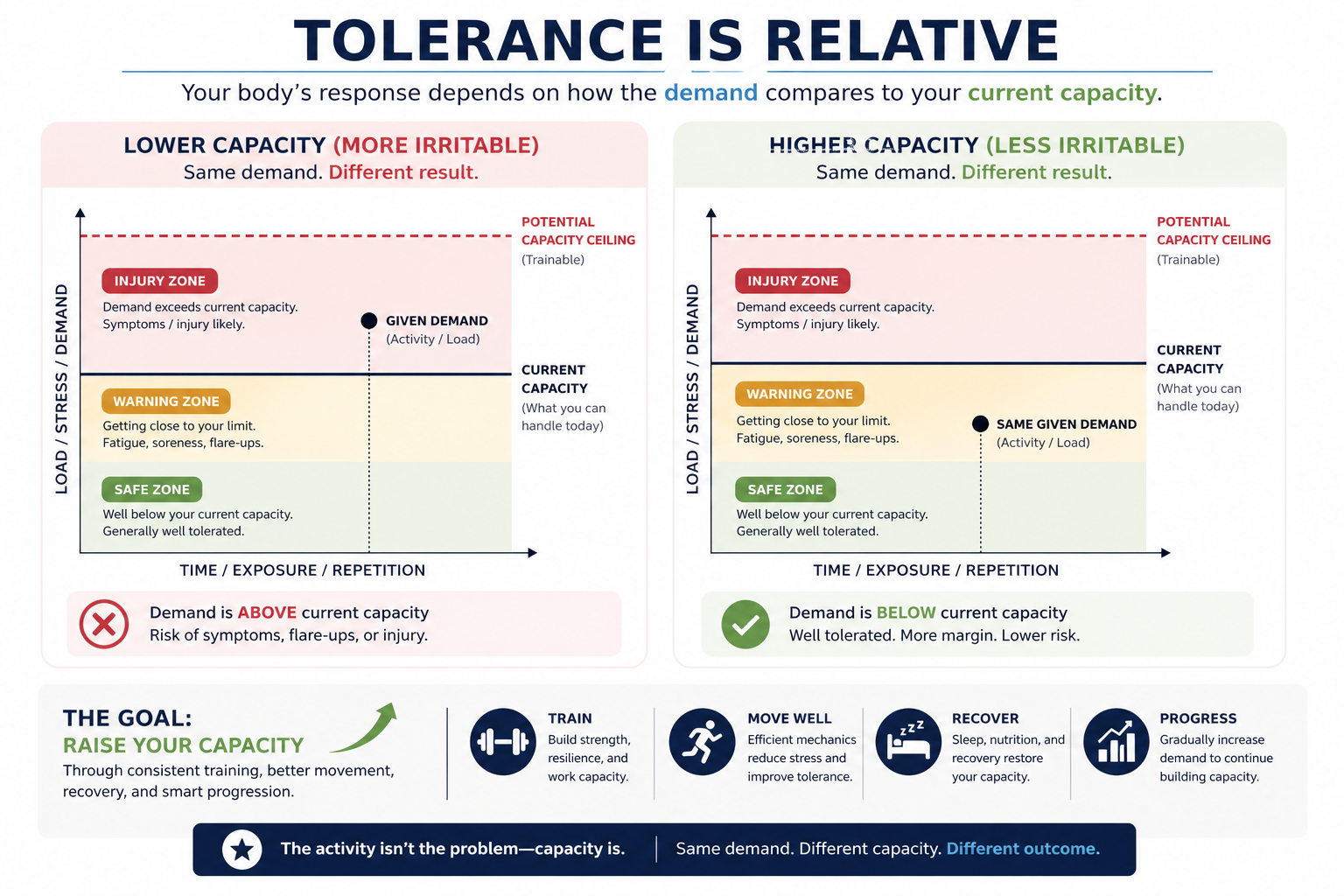
Think of your body like a system with a current capacity(what it can tolerate today), and a potential capacity (what it could handle if properly trained).
Now place a specific activity on that spectrum:
Below your current capacity → safe zone
Near your capacity → warning zone
Above your capacity → injury zone
This is where symptoms start to make sense.
Symptoms are not the problem. They are a signal.
They function like a warning alarm, telling you that you are approaching your current limit. If you continue to push past that threshold, the likelihood of injury increases. Pain isn’t random, and it isn’t the enemy, it’s information.
Why Symptoms Feel Sudden
Most injuries don’t come from a single moment. They come from a pattern.
A common sequence looks like this:
You feel a little tight or sore
You ignore it because you can still function
You continue doing the same activities
Eventually, something small pushes you over the edge
It feels like it came out of nowhere, but your body has been signaling for some time. The volume simply increased when the threshold was crossed.
The Mistake Most People Make
When symptoms show up, the natural reaction is to try to eliminate them as quickly as possible.
Rest. Ice. Modify. Avoid.
Sometimes that helps in the short term. But if your capacity hasn’t changed, neither has the underlying problem.
This leads to a familiar cycle:
Rest → feel better → return to activity → symptoms return
Why? Because the demand is still too high relative to what your body can tolerate.
The Real Goal of Treatment
The goal is not simply to remove discomfort.
If symptoms are just a warning signal, then eliminating the signal without changing the system doesn’t solve anything. It just quiets the alarm temporarily.
That means:
Gradually increasing what your body can handle
Improving how forces are distributed through your system
Allowing time and recovery for adaptation
Progressing in a way that stays just below your threshold
Over time, your current capacity moves upward toward your potential ceiling.
Now the same activity that once caused pain becomes well tolerated.
Same demand. Different result.
There is another piece most people overlook: the body adapts at a specific rate.
You cannot rush it indefinitely.
Tissues need time to remodel. The nervous system needs time to coordinate. Capacity improves, but it does so on a timeline that has biological limits.
This is where the modern “no days off” mentality creates problems.
Pushing hard every day can feel productive in the short term, but over time it often leads to the exact pattern we’re trying to avoid:
Load increases faster than the body can adapt → capacity lags behind → symptoms appear
This is the reverse of intelligent training.
Progress isn’t about doing more at all costs. It’s about applying enough stress to drive adaptation, then allowing that adaptation to occur.
When you respect the rate of change, capacity rises steadily.
When you ignore it, you accumulate fatigue and drift toward injury.
Capacity isn’t just about strength or endurance. It’s also about how efficiently your body moves.
If one area isn’t doing its job, another area compensates.
That compensation increases stress locally, lowering your effective capacity, even if you’re strong in a general sense.
This is why two people with similar strength levels can have very different outcomes.
Instead of asking:
“What’s wrong with me?”
A more useful question is:
“What am I currently asking my body to do that it isn’t prepared to tolerate?”
That shift moves the focus away from chasing symptoms and toward understanding the relationship between demand and capacity.
The activity is rarely the problem.
Running, lifting, playing pickleball, these don’t cause injury on their own. They only become a problem when they exceed your current capacity.
Your body is adaptable, but adaptation requires the right inputs: appropriate stress, efficient movement, and adequate recovery.
When those are in place, capacity increases.
And when capacity increases, the same life becomes easier to live.
The goal isn’t to silence the alarm.
It’s to build a system that can handle the demands placed on it, at the right pace.